
In dentistry, an invisible problem can lead to major complications if it is not detected in time. Although visual examination and traditional 2D X-rays are valuable tools, they have their limits. Modern technology, however, gives us a much clearer picture, allowing dentists to see beyond appearances and draw up a precise and effective treatment plan.
What is a 3D dental X-ray (CBCT)?
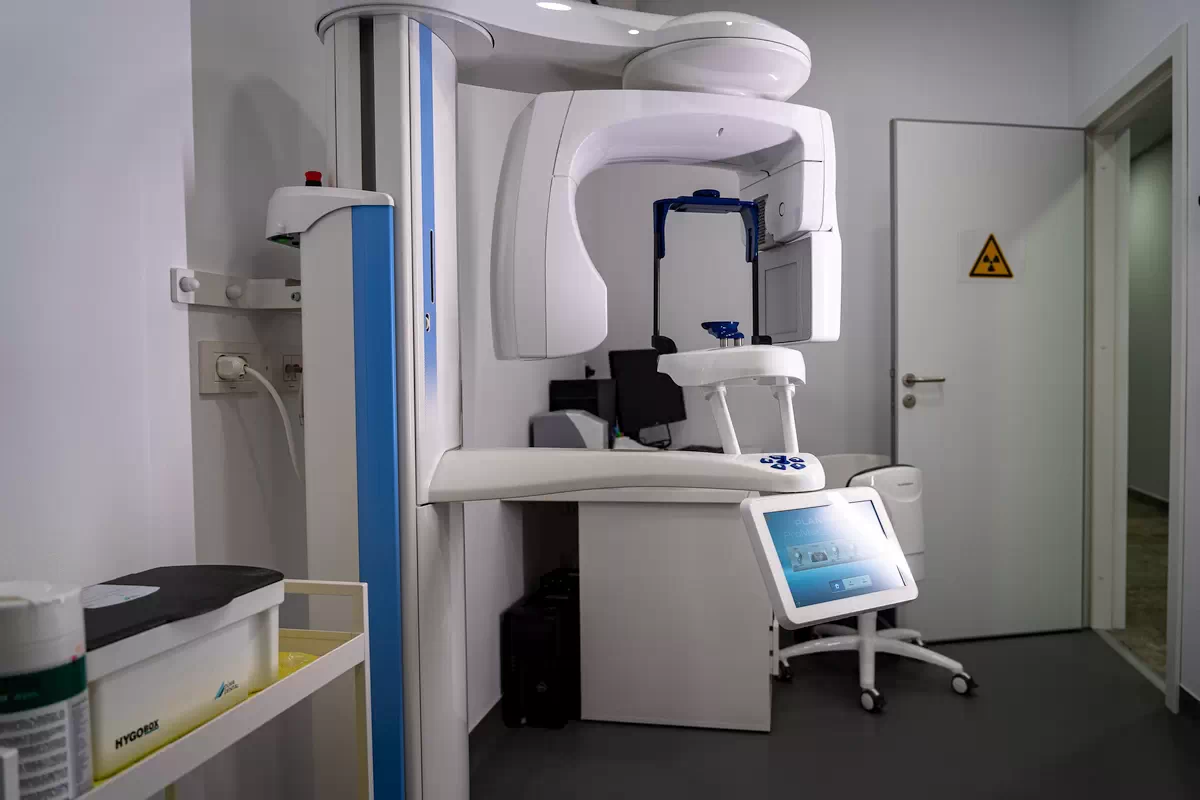
A 3D dental X-ray, known as CBCT (Cone Beam Computed Tomography), is an advanced imaging method that creates a three-dimensional map of the jaw and dental structures. Unlike a conventional 2D X-ray, which gives a flat image of the whole area, CBCT lets the dentist view anatomical details from any angle. This produces a complete and accurate image of the bone, teeth, nerves and airways, which is essential for a correct dental diagnosis.
Advantages of 3D X-rays
3D X-rays bring a number of benefits for both the dentist and the patient:
- A complete, detailed image: It gives an overall view of the entire jaw, precisely identifying root infections, cysts or other hidden conditions.
- Precise planning: It is an indispensable tool in implantology, allowing the dentist to determine the exact position, angle and depth at which the dental implant will be placed, minimizing risks. It is just as useful in dentoalveolar surgery.
- Reduced radiation exposure: Although it provides a much more detailed image, CBCT uses a much lower radiation dose than a traditional medical CT scan.
When is a 3D X-ray needed?
We recommend a 3D dental X-ray in the following situations:
- Preparing for a dental implant: To assess the quality and quantity of the available bone and to identify important anatomical structures.
- Complex root canal treatments: To locate extra canals or root fractures that cannot be seen on a 2D X-ray.
- Assessing impacted teeth: Especially for wisdom teeth, CBCT shows the exact position of the tooth in relation to the nerve in the jaw, reducing risks during extraction.
Conclusion
A 3D dental X-ray is an essential part of modern dentistry. At Dental CATTED we use modern dental technology for a fast and accurate diagnosis. This means every treatment is personalized and planned on the basis of clear images.
Book your appointment now!
Find out how we can help you prevent and treat invisible dental problems. Call +40 733 22 88 28 or fill out the contact form to arrange an appointment.