
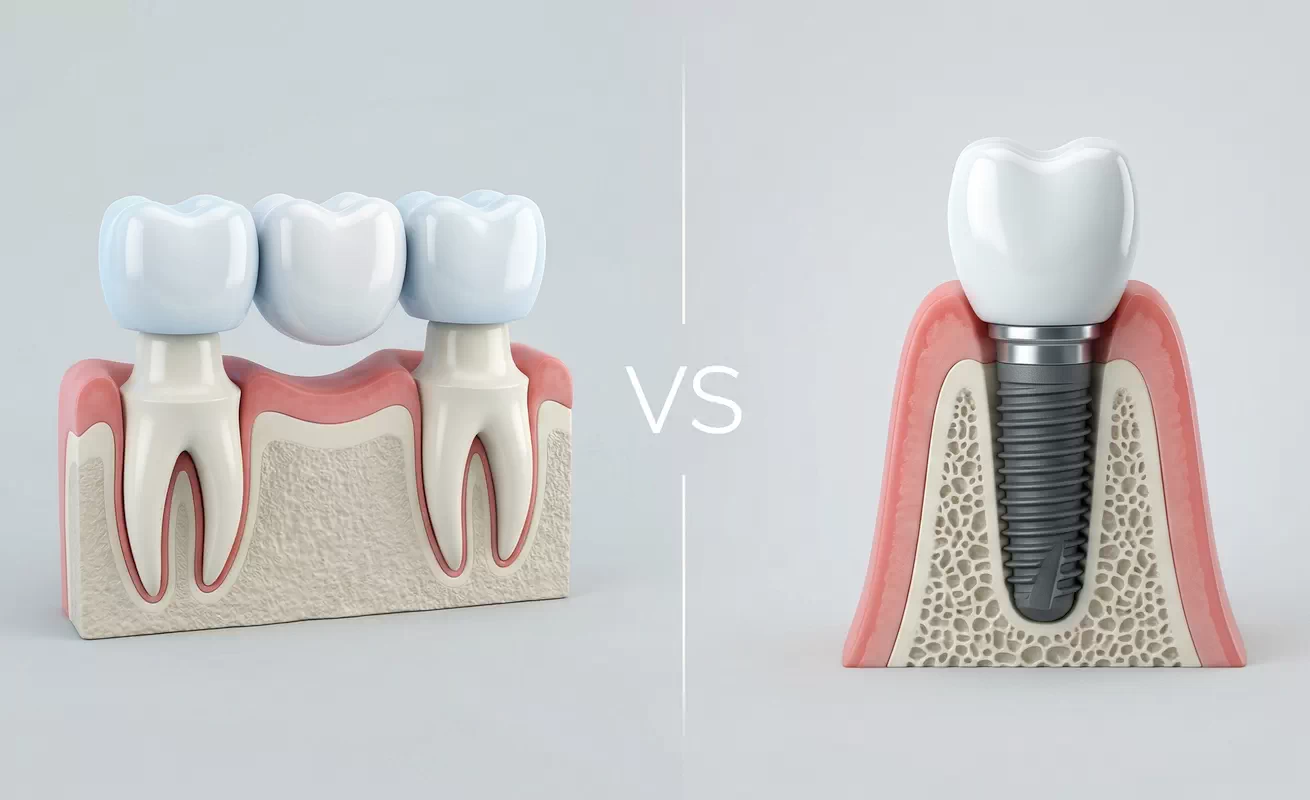
When you lose one or more teeth, the question inevitably comes up: Dental bridge vs implant – which is the right choice?
Both are effective ways of replacing missing teeth, but they differ significantly in terms of durability, cost and how they are carried out.
In this article we clearly explain the benefits and limitations of each option, so that you can understand what suits your real situation, not just in theory.
What a dental bridge and a dental implant are
Both the dental bridge and the dental implant are commonly used in dentistry to replace missing teeth, and each has specific indications.
Dental bridge
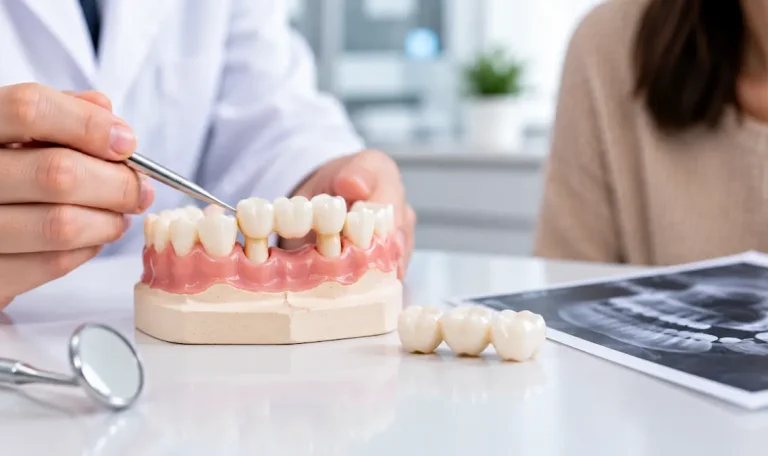
A dental bridge is a fixed restoration that:
- is supported by the neighboring teeth (which are prepared, i.e., filed down)
- replaces the missing tooth with a pontic (the false tooth of the bridge)
- gives quick results, in a few appointments
It belongs to the category of prosthetic restorations, along with crowns and dentures.
👉 It is a suitable option when the patient wants a quick solution without surgery.
Dental implant
A dental implant is a modern, more complex solution that:
- involves placing a titanium implant in the bone
- replaces the root of the missing tooth
- later supports a dental crown
For a complete understanding of the stages, you can read our guide to replacing missing teeth.
👉 Unlike a bridge, an implant is a stand-alone solution that does not affect the neighboring teeth.
Dental bridge vs implant: what is the real difference?
The main difference is not just the procedure, but how each solution affects your oral health in the long term.
In short:
- a dental bridge uses the neighboring teeth as support
- a dental implant replaces the whole tooth, including the root
👉 There is no universal right choice – it depends on the clinical context.
For example:
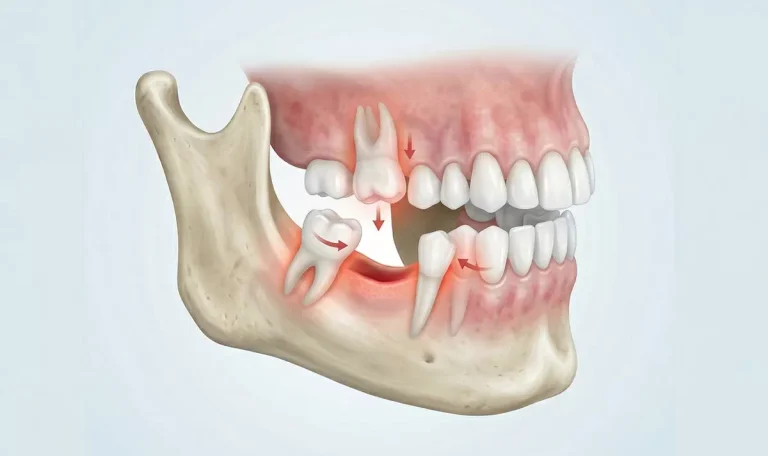
- if there is not enough bone → an implant may require bone grafting
- if the neighboring teeth are already compromised → a dental bridge may be more suitable
- if you want a long-term solution → an implant is usually the preferred choice
In general, when there is enough bone, a dental implant is the medically recommended solution, because it does not involve damaging the neighboring teeth.
However, from the patient's point of view, two aspects may be important:
- the longer time until treatment is completed
- reluctance to undergo surgery
In these situations, a dental bridge can be a suitable alternative.
A real example from practice:
A patient with one missing tooth and enough bone chose a dental implant for a durable solution that would not affect the neighboring teeth. In another case, where the adjacent teeth already had restorations, a dental bridge allowed the smile to be restored quickly and effectively.
👉 In clinical practice, we often see that the final choice is influenced not only by the medical indication but also by the patient's preferences and comfort.
When you need to choose between a bridge and an implant
The decision between a dental bridge and an implant often comes up in situations such as:
- one or more missing teeth
- severe damage to a tooth (e.g., a broken tooth or a lost filling)
- the need to restore your smile quickly
The choice depends on several factors:
- the available bone volume
- the condition of the neighboring teeth
- your budget
- the time available for treatment
👉 In practice, the right question is:
“What is the right solution for my situation, now?”
Pros and cons of a dental bridge
Pros
- relatively quick treatment (completed in a few appointments)
- no surgery required
- can be an effective solution when the neighboring teeth already need treatment
Cons
- requires the neighboring teeth to be filed down
- does not prevent bone resorption where the tooth is missing
👉 When it is made correctly and maintained with thorough hygiene and regular checkups, a dental bridge can last a long time.
Pros and cons of a dental implant
Pros
- does not affect the neighboring teeth
- helps prevent bone loss
- offers function and appearance very close to natural teeth
Cons
- involves surgery
- the treatment takes longer (depending on integration with the bone)
- may require additional procedures (e.g., bone grafting), which add to the complexity and cost
👉 In favorable conditions (enough bone and good hygiene), an implant is often recommended as the first-line solution.
Cost, durability and recovery
Cost is an important factor when choosing between a dental bridge and an implant, but it has to be considered in the specific clinical context. You can find details on how much a dental implant costs and what the price includes in a separate article.
In standard cases, when there is enough bone and no additional procedures are needed, the costs of a dental bridge and an implant can be similar.
The differences arise mainly when:
- bone grafting is needed
- the case involves additional procedures
- the treatment plan becomes more complex
The final cost is always set after a personalized treatment plan, depending on the specifics of each case.
For an indication of fees, you can look at our dental treatment prices page, which covers different types of treatment.
Durability
Both a dental bridge and a dental implant can last a long time if they are made correctly and maintained through:
- thorough oral hygiene
- regular checkups
- regular professional cleanings
👉 The difference is not necessarily in “how long they last”, but in how they affect the dental structures in the long term.
How to choose correctly between a dental bridge and an implant
There is no one-size-fits-all solution – the choice always depends on the specifics of each case.
The dentist will assess:
- bone volume
- the position of the missing tooth
- your general oral health
- your aesthetic expectations
👉 In general:
- a dental bridge is recommended when the neighboring teeth are already compromised or when a quick solution is wanted
- a dental implant is preferred for stable, long-term results
👉 The choice between a dental bridge and an implant should always be made on the basis of a specialist consultation.
Frequently asked questions (FAQ)
Which lasts longer: a dental bridge or an implant?
A dental implant generally lasts longer and can last more than 15–20 years with good hygiene. A dental bridge has a shorter average lifespan and needs replacing from time to time, depending on wear and the health of the supporting teeth.
Is the dental implant procedure painful?
The procedure is carried out under local anesthesia, so you should not feel pain during the procedure itself. Afterwards there may be some discomfort and mild inflammation, which are temporary and can be managed effectively with medication recommended by your dentist.
How long does dental implant treatment take?
The total time varies between 3 and 6 months, depending on how the implant integrates with the bone. In some cases faster options exist, but they depend strictly on the patient's clinical conditions and the dentist's assessment.
Can a dental bridge be made without filing down the neighboring teeth?
Conventionally, no. A dental bridge requires the neighboring teeth to be filed down to support it. There are minimally invasive alternatives, but they are only indicated in specific cases and must be assessed individually by the dentist.
Which option looks more natural?
Both options can give good aesthetic results. An implant has the advantage of mimicking the structure of a natural tooth more closely, including at gum level, which is why it is often preferred for front teeth.
Book a consultation
If you have missing teeth and are not sure whether to choose a dental bridge or an implant, a clinical assessment is the most reliable way to decide, as the dentist can look at exactly what is specific to your case.
At Dental CATTED, every case is assessed individually, and our dentists will explain clearly what options you have and what each one involves in your case:
- what options you have
- what each treatment involves
- which solution is most suitable for your clinical situation
👉 Book a consultation and find out exactly which solution is right for you, without compromising your dental health.
📞 Call +40 733 22 88 28
📩 Or fill out the contact form in the sidebar and we will call you back as soon as possible.
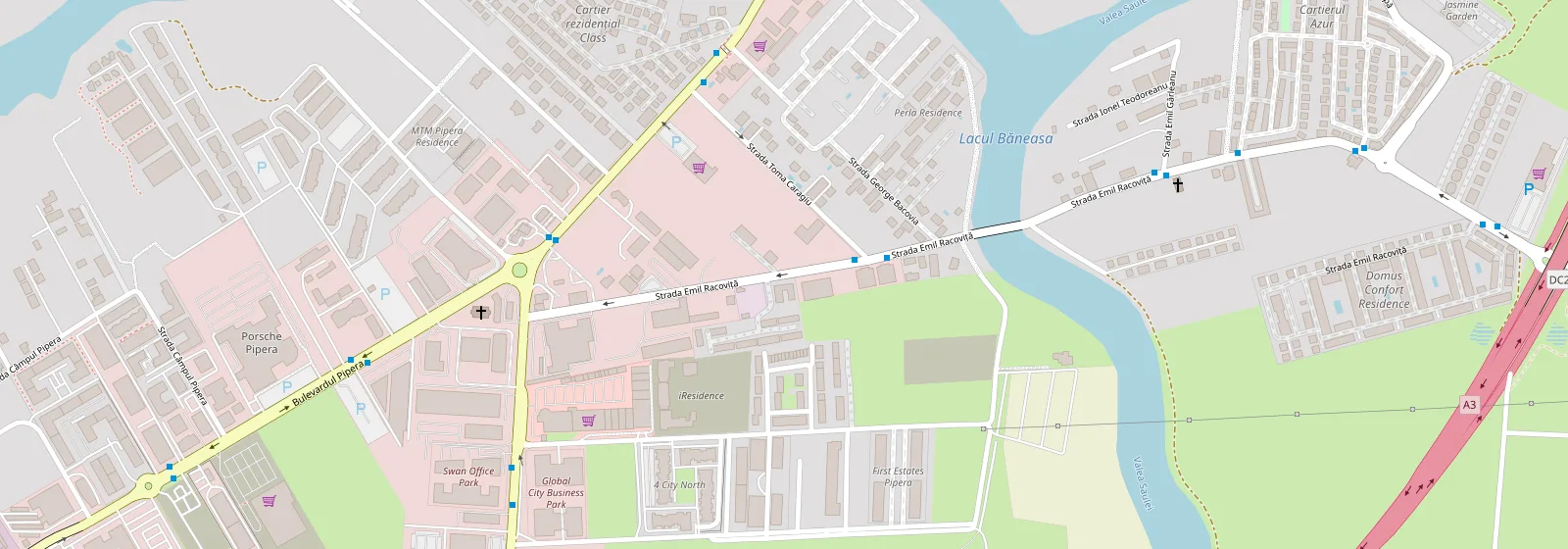
📍 Pipera, Str. Emil Racoviță 26
Dental CATTED Dental Clinic – Pipera